 Zebra Krillion



How to play Zebra Krillion Practice
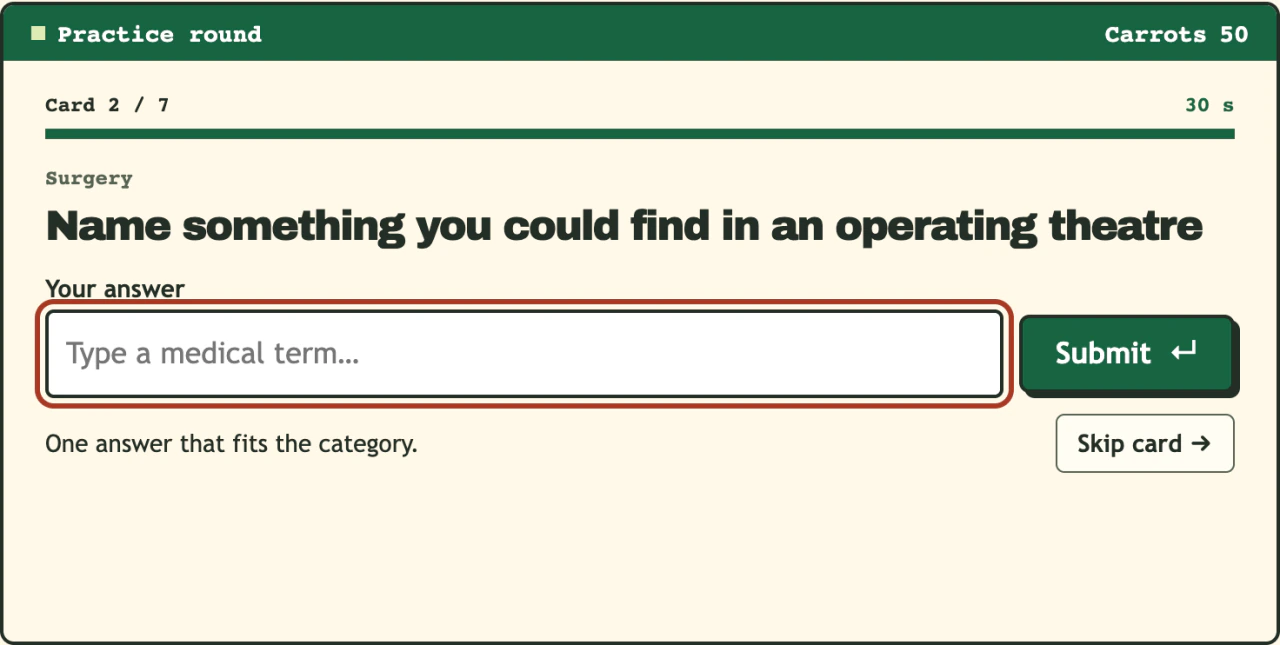
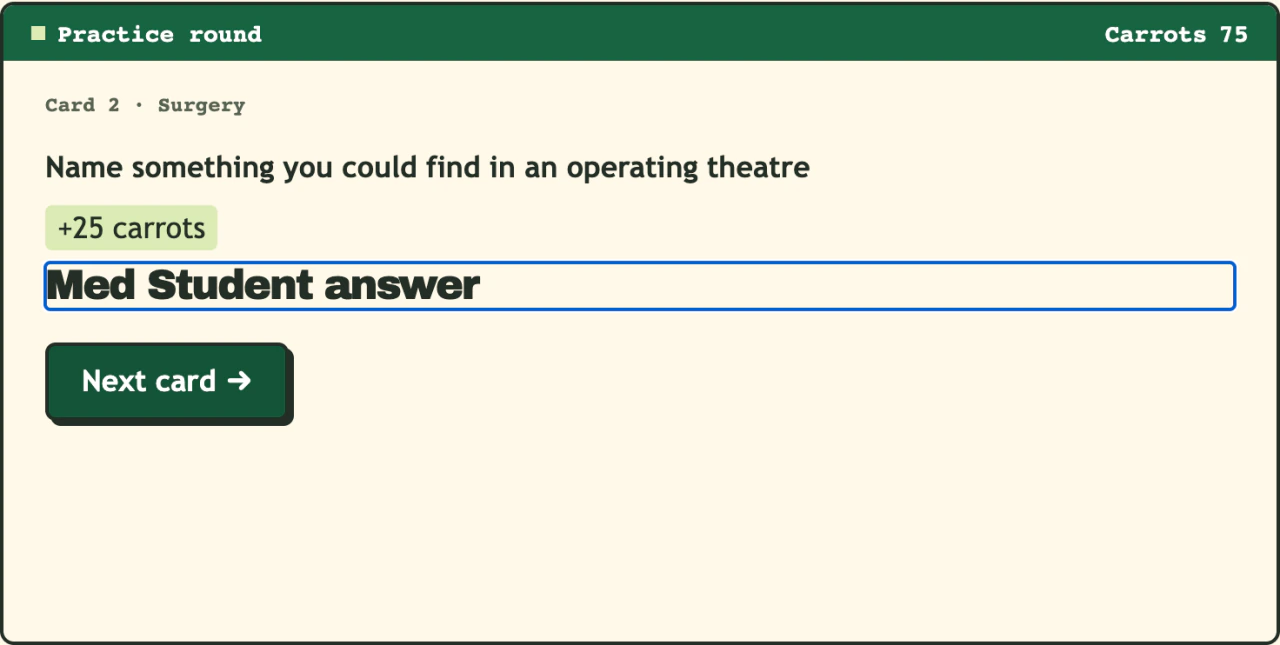
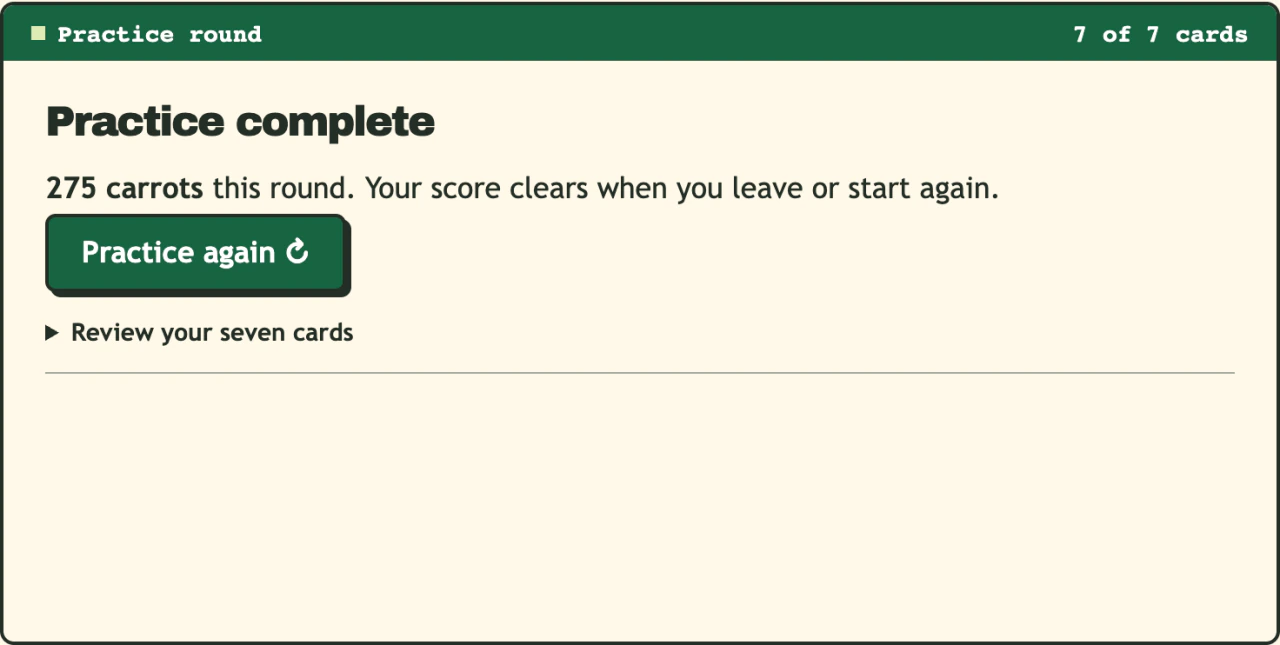
Choose Start practice round to draw seven medical trivia cards. Each card gives you 30 seconds to type one answer, and its recap shows how many carrots that answer earned. Once you reach the last card, you can read the full review or shuffle again. The deck has a fixed set of prompts, so individual cards can reappear across rounds. Within one round, each card appears only once.
See the three gameplay screens from a completed round.
On a keyboard, type in the answer field and press Enter or select Submit. On a phone, tap the field, type the term, and tap Submit. A correct match locks in the answer and stops the clock. If the sheet has no match, the field stays open so you can replace your entry. Use Skip card when you're ready to see an example. The recap stays open until you move on, which gives you time to read it before the next clock starts.
Read the final words before you answer
One of the mixed cards asks for a body part visible on a plain chest X-ray. The important phrase is “body part.” A lung is the right kind of answer. A finding you might see on a film belongs to a different question. On another card, “something unusual you could see on a blood film” does invite a finding. Reading those final words helps you tell two imaging and laboratory prompts apart before the first guess.
Initial letters can be just as important. A condition beginning with G and one beginning with P make separate cards. Both draw from the same broad vocabulary, yet only the requested initial completes the clue. When you think of a term with several names, choose the name that follows the wording and type it as a single entry. A string of possibilities is harder for the answer sheet to interpret, even if one of the words is on it.
What is in the mixed medical deck?
The practice draw uses the general Zebra question bank. Its prompts move through cardiology, radiology, blood films, enzymes, kidney disease, hearing, and operating-room vocabulary. In one round you could go from naming a cause of a fast heart rate to recalling an implantable device. Next time the order could put a question about hearing loss beside one about an enzyme the body makes. The range makes this deck a good first stop when you want to switch subjects at game speed.
Some cards point to a place or tool. For an operating-theatre prompt, picture the room and work outward from the table to instruments and equipment. Some cards ask what could cause a finding. For those, read carefully enough to distinguish the condition named in the clue from the cause you need to supply. That choice matters even when both terms are familiar to you.
A short practice set also makes it easier to see which kinds of questions cost you time. A forgotten word gives you a different thing to review from a misread instruction. If you recognize nearly every prompt yet miss several answers, check whether you keep offering examples when the question wants a category, or offering a category when it wants the name of an individual item.
How carrot scoring works
A matched answer earns 10, 25, 50, 75, or 100 carrots. The tiers shown in the recap are Pre-med, Med Student, Resident, Attending, and Professor, respectively. The number comes from that card's answer sheet. A spelling or alias that resolves to the same entry gives the same number of carrots, and skipped or timed-out cards contribute zero. Seven cards make 700 the theoretical ceiling. A particular draw can have a lower ceiling when a card's listed answers stop below 100.
A reliable match is worth taking when the timer is tight. With more time, you can hold a candidate in mind and consider whether you know an equally sound, less obvious answer. The risk is that an obscure candidate may be hard to spell or may fall outside the wording. Decide how much of the clock you want to spend on that search before you start typing. The game records the first accepted entry, so the recap is the place to think about alternatives for a future round.
An answer that fails to match leaves room for a retry. Look first at whether the term actually fits the category, then try a spelling or an established alternate name if you know one. You can also take the zero and read the example. The displayed example demonstrates one accepted response and gives you a concrete way to understand the prompt before the next card.
How to review a seven-card round
At the end, open Review your seven cards. Each row pairs the prompt with your matched entry or a skip or timeout marker, plus the carrots earned. Read the rows in the order you played. On a successful card, check which word the game displayed for your answer. On a miss, recall the example you saw on the recap and read the prompt again to identify the condition it imposed.
Consider a round in which you answer four cards and let three clocks expire. Start with one of those three. If you had a term in mind but never typed it, practice committing your first sound choice earlier. If you spent the time testing names from the wrong branch of the subject, repeat the clue aloud with its required answer type. One small correction is easier to carry into the next shuffle than a general instruction to play faster.
The review belongs to the round you just finished. Use it before refreshing, leaving the page, or choosing Practice again. This warm-up keeps its answers and score in the current play session. The daily attempt, streak, animal unlocks, and logbook follow their own rules and remain available through the regular Zebra game.
Choose practice, daily, or another deck
Use this page for a bounded session and the option to replay right away. In the daily round, players on the same UTC date receive the same seven prompts, so it is the natural choice when you want to compare a result with a friend. The archive is where you can choose a past date and revisit its original order. Unlimited has a different stopping point. You keep taking cards until you choose to finish, and that run can appear in your logbook.
Switch to Pharmacy Krillion if you want to spend all seven cards on medicine vocabulary. Its questions distinguish forms, routes, classes, and abbreviations. Anatomy Krillion focuses on the names and relationships of bones, joints, and muscles. The controls are the same, so you can change subject without learning a new game. A specialty round gives you more practice with that vocabulary, while the mixed deck makes you decide which subject a question belongs to as well as recall an answer.
For a first visit, play through one seven-card run and choose the next deck from the review. A difficult kidney or cardiology prompt might be worth revisiting in the mixed round, while a question involving a precise structure might send you toward anatomy. If your priority is simply to get used to the interface, practice submitting, retrying, and skipping once each. Those three actions are enough to move through any of the decks.
What you need to start
Zebra Krillion Practice is free to play online in a browser with JavaScript enabled. You can play on a phone, tablet, or computer. Everything you need for the round is on this page, with no sign-up and no download. The first clock begins when you start and the cards are ready, so you can read the instructions or pick a specialty beforehand. If the cards fail to load, the start button becomes available again. Check your connection and retry from the same page.
The prompts and their scores make this a game about recall. The cards can help you notice a word you want to look up later, and the recap shows how the game matched it. Clinical decisions belong with current references and qualified professionals. For your next round, bring one term from the review back to mind and see whether you can place it in the right category without the example.
A round in screenshots