 Zebra Krillion

Pharmacy Krillion, the medicine vocabulary deck in Zebra Krillion
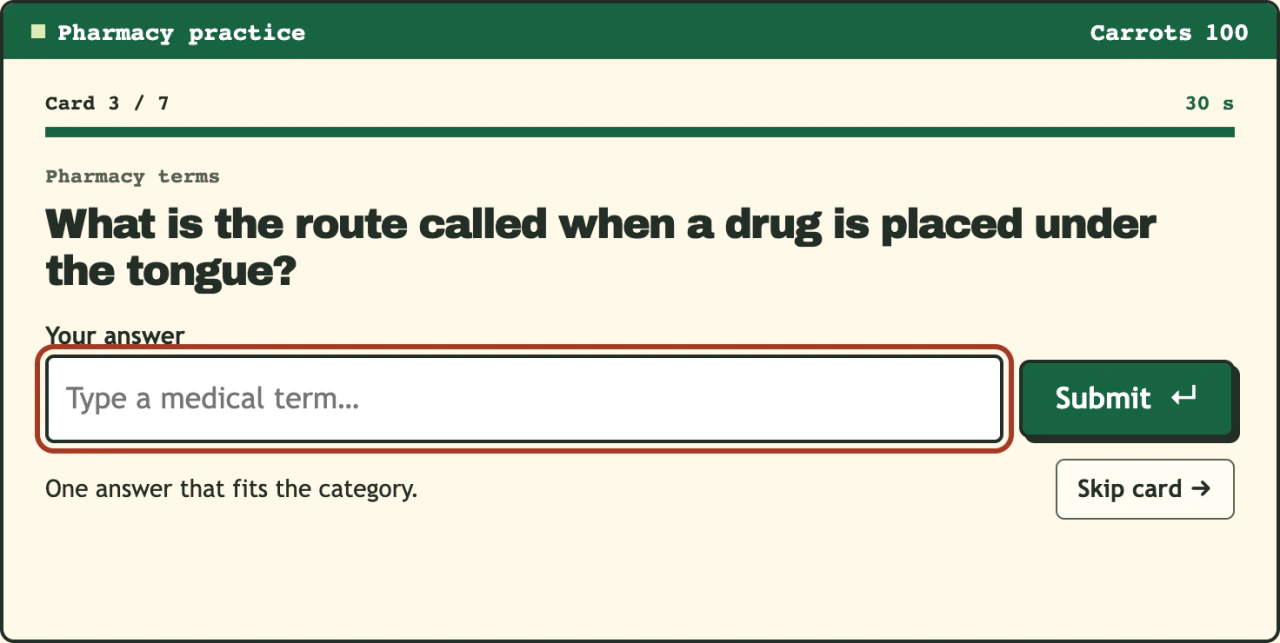
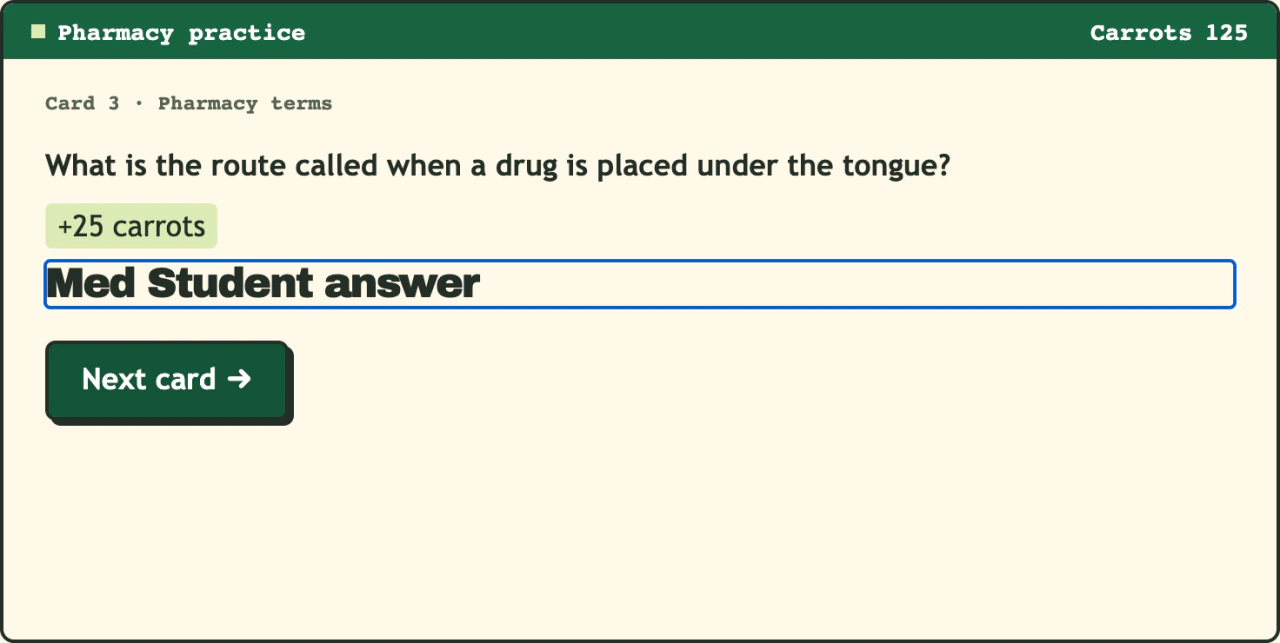
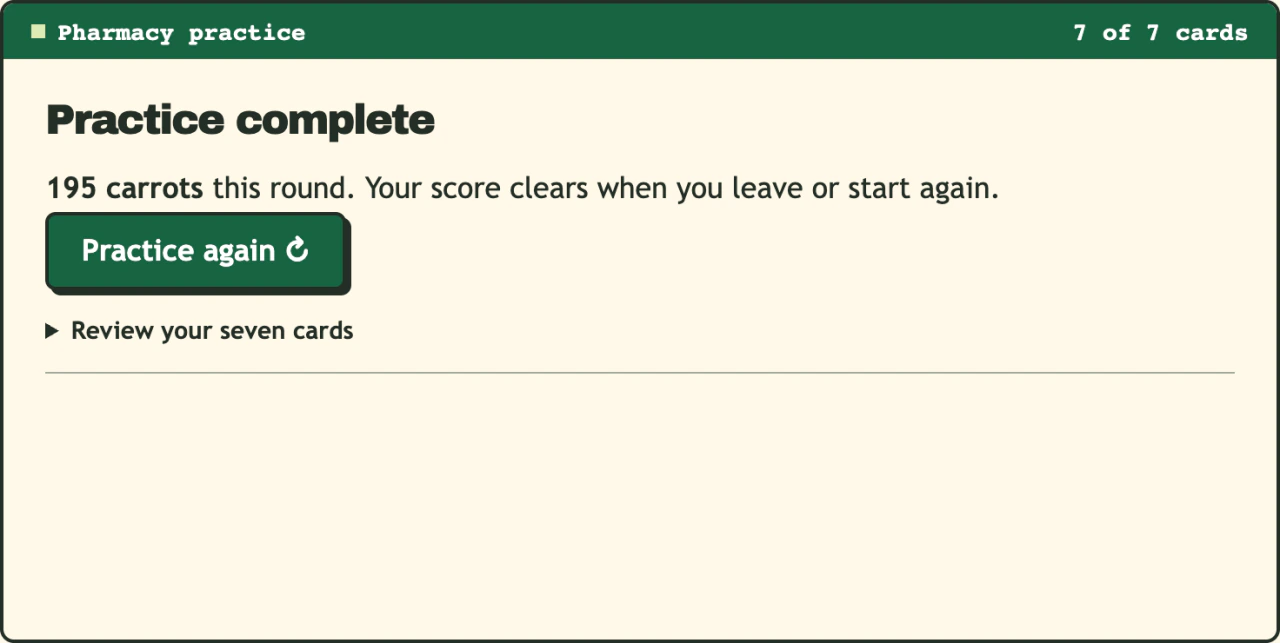
In this Zebra Krillion deck, you play seven cards from a set of twelve. Each clue gives you 30 seconds to recall a pharmacy term and enter it in the browser. You might complete a generic drug name, identify the route described in a sentence, or expand letters printed on a medicine document. A matching word earns carrots and opens a recap. At the end, you can inspect your seven entries and shuffle another round. The game runs online for free, with no sign-up and no download.
See the three gameplay screens from a completed round.
This deck makes you produce the term yourself. The clue might give you a prefix or two familiar examples, but you still type the word that connects them. If you have ever recognized a term on a page and then struggled to recall it from memory, that gap is what a card lets you practice. You can play as a student checking vocabulary or as a trivia player curious about the language used around medicines.
Start with the kind of word the clue wants
Separate the clue into a subject and a task. In “Which drug class do ibuprofen and naproxen belong to?” the examples give you the subject and “drug class” tells you what to enter. NSAID fits the answer sheet for that card. If you see a stem such as ATORVA-, the task changes to completing a generic name. Read the verb and the requested answer type before reaching for the first familiar term.
Choose Play Pharmacy Krillion to start the clock on card one. Use Submit or Enter to check one candidate. When the entry misses, the field stays open while time remains. You can edit it and submit again, or use Skip card to see an example. The timer waits until you advance from each recap. Take that moment to recall the reason an answer fits, especially when it took you several attempts to find one.
Dosage forms in Pharmacy Krillion
The form cards ask you to name the physical form of a medicine. On the solid oral form card, the two gaps point to tablet and capsule. Complete either term. A liquid form clue gives the beginnings of solution, suspension, and emulsion. A separate card works with cream and ointment. For these prompts, count the characters or read the full prefix first. A quick glance can cause you to add an extra letter to a word you already know how to spell.
Notice what the clue commits you to. If it asks for something that begins with a particular prefix, a real form with another name still falls outside that question. If a card offers several patterns, choose the one you can complete confidently. There is no need to fill every gap on screen. The game checks one entered term, and presenting a single word also makes it easier to spot a typo before submitting.
Routes of administration
A route question describes the place or path in the clue. Buccal refers to the inside of the cheek. Sublingual refers to placement under the tongue. One card names a tablet in the scenario and still asks for the route. Imagine where the tablet goes and name that placement. The noun “tablet” can help you visualize the clue while the words “inside of the cheek” decide the answer. FDA route of administration terminology
Another prompt accepts a route name associated with either the eye or the ear. If both possibilities come to mind, choose one and check its spelling. Keep the endings distinct when you review. A pair of related words can be helpful in your own notes, where you have space to write which body part goes with each. During the round, enter the single route that the game asks you to name.
Drug classes and pharmacy abbreviations
On a class card, the named medicines are clues. The loratadine and cetirizine prompt asks for the class that connects them. A statin card goes in the other direction. It gives you beginnings of generic names and asks you to complete one. A class label alone is too broad for that card. A useful way to study the difference is to put a class name on one side of a note and keep the individual generic names together on the other.
Abbreviation cards ask for different levels of detail. One gives API and wants its expansion in a medicine specification. Another presents NDA and ANDA and asks for the single word added by the extra A. OTC appears in the context of a pharmacy shelf. Before answering, count how many words the clue requests. An abbreviation can also be an accepted answer to a class question, as with NSAID. The clue's instructions tell you whether to type letters, expand them, or pick out just one word.
How the deck scores a recall attempt
Carrots belong to the matched entry on each card. On the solid forms card, tablet gives 10 carrots and capsule gives 25. On the liquid forms card, the values are 10 for solution, 25 for suspension, and 50 for emulsion. When the game accepts another spelling for the same entry, it gives the same score. The different values are properties of the game sheet. They provide a reason to think of a second possible answer and a way to count your score across the round.
Both the draw and your choices shape the total. Some cards have a single accepted concept, while others let you pick among several terms with their own values. A skipped card or a clock that runs out gives zero. You can use your first round to see how many cards you can match, then use later rounds to try other accepted words where the clues provide options. The recap shows the value as soon as you land a match.
Use the review to practice a specific distinction
Open Review your seven cards at the end. Pick a card you missed and compare the prompt with the answer you remember trying. If it was a route question, identify the part of the description that places the medicine. If it was a drug name, try completing its prefix on paper from memory. When you get an abbreviation wrong, say its full expansion aloud in the context given on the card. A single distinction like cheek versus tongue is easier to remember on your next turn than a long list of loosely related terms.
A draw can contain six or seven words you have already seen, especially after several plays. Try to answer a familiar clue without relying on its position. The shuffle may put the same clue after a different topic next time. If the word comes easily in both settings, use the review to find a second item worth practicing. Select Practice again when you are ready to replace the current round with another draw.
Pick your next Zebra round
Choose Zebra Krillion Practice for a mixed seven-card warm-up that moves through general medical topics. Try Anatomy Krillion if you want a session about bones, joint shapes, and muscles. Each page has its own deck, and the controls carry over. Use the Zebra daily round when you want to play the same set as someone else on the same UTC date.
The specialty score stays with the current practice round. Review it before you refresh or leave. The deck focuses on terminology and recall, and its points measure what the game matched. For a short session, aim to explain one answer in your own words after the recap. Then try to recall that explanation the next time the clue appears.
A round in screenshots