 Zebra Krillion
Anatomy Krillion, the human anatomy deck in Zebra Krillion
This Zebra Krillion deck is a free online quiz about human anatomy. Type one answer at a time. Each round draws seven cards from a twelve-card deck about bones, joints, and muscles. You get 30 seconds per card. A matched answer gives you carrots, and after card seven you can look back at the prompts you played. Open it in a browser with no sign-up and no download.
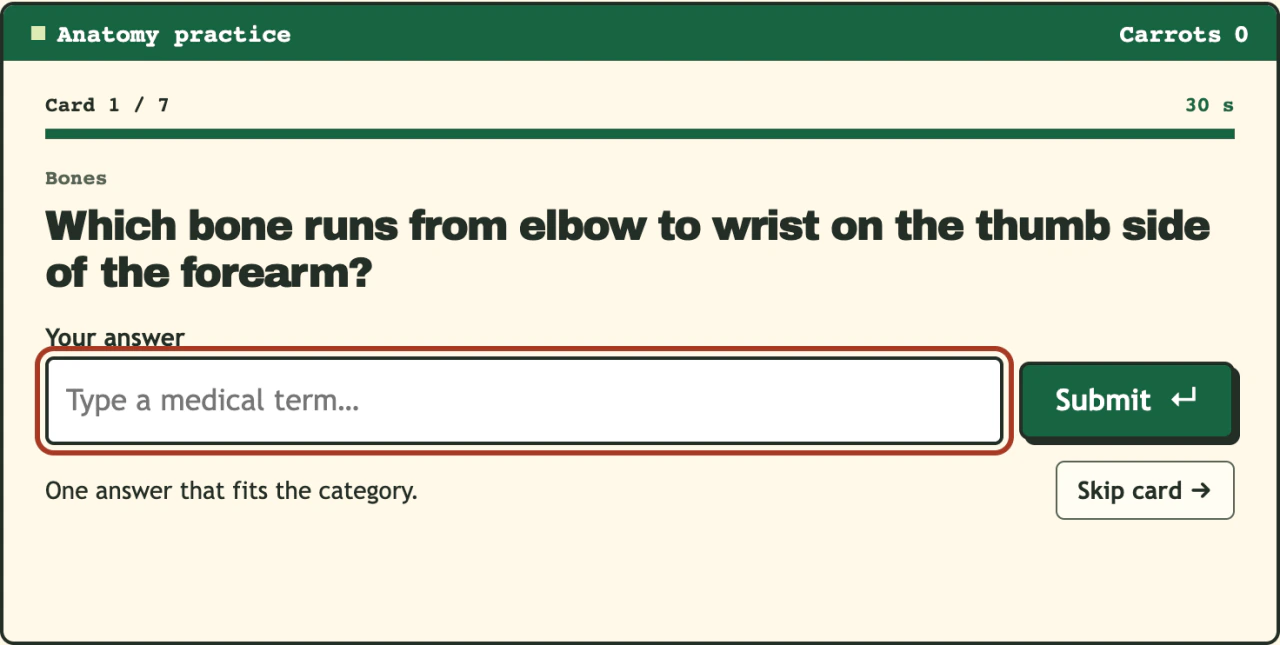
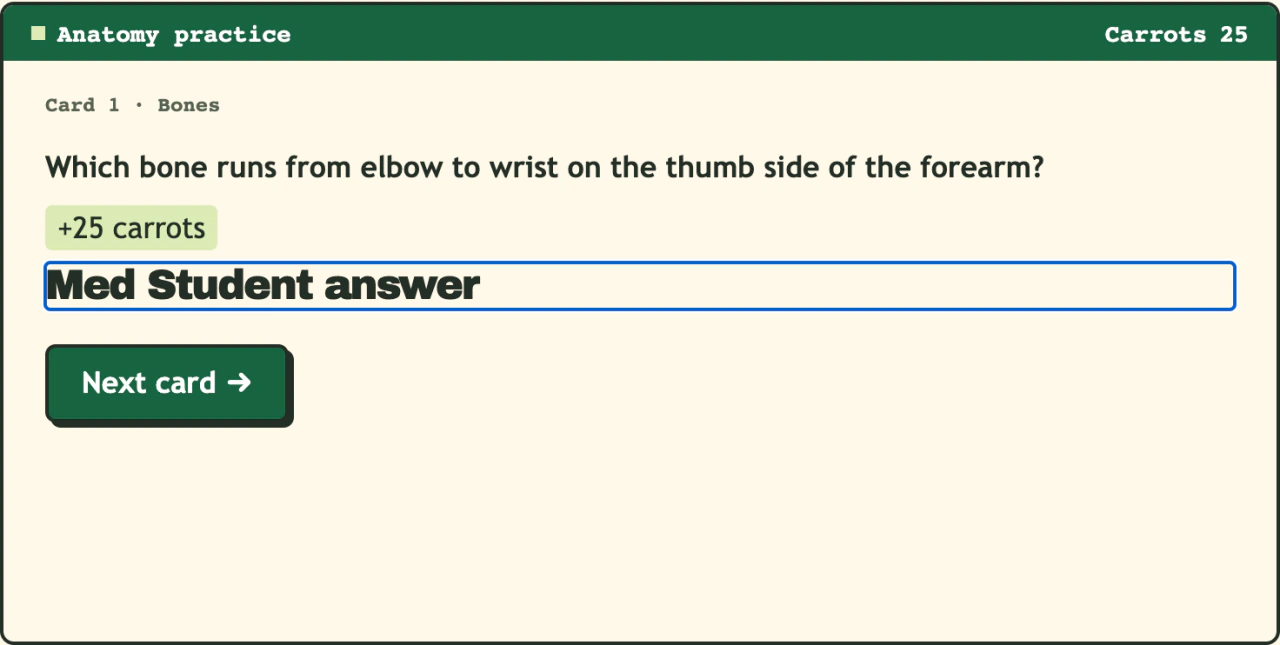
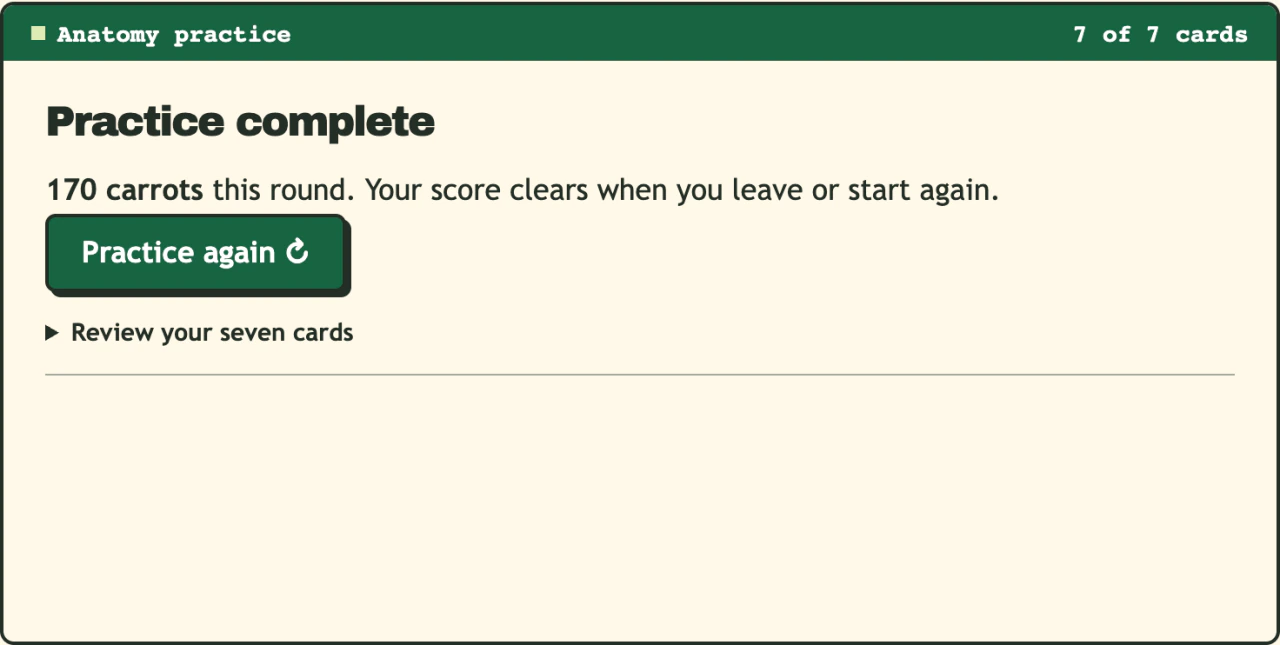
See the three gameplay screens from a completed round.
Some prompts can be pictured as a simple skeleton. Others ask you to identify the precise part of a joint or name a muscle by the movement it helps produce. The clues are short enough to reread while the clock runs. You can start with familiar structures, then use later rounds to spend more time on terms you tend to confuse.
Follow the landmarks in the clue
A question about the thumb side of the forearm gives you two useful anchors. First, the answer spans elbow to wrist, so you are looking within the forearm. Second, the thumb side in anatomical position points to the radius. Think of a person standing with palms facing forward. The same pairing is easier to recall when you attach the term to that image than when you memorize two bone names in isolation. OpenStax, bones of the upper limb
A card about the shoulder girdle works differently. It asks for either of the two bones on one side, so you can use clavicle or scapula. If you remember the familiar word first, the sheet for this card also recognizes collarbone and shoulder blade. Choose one structure and enter its name. You can keep the second answer in mind for another round, when the shuffle puts this card elsewhere in the sequence.
Landmarks help with knee and thigh prompts too. The femur is the long bone of the thigh, while the patella is the kneecap. A question that draws a region between two points often wants a structure spanning that region. A question that gives you an everyday name can ask you to translate it into anatomical terms. Use the landmarks to place the word, then check which kind of response the wording calls for.
Joint shape, joint name, and socket
The deck asks about joints at several levels. A ball-and-socket prompt accepts the hip or shoulder. The thumb-base card instead asks for the shape of the joint connecting the trapezium to the first metacarpal. On that card, type saddle joint. Saying “thumb” identifies a general location. The words “by shape” are the cue to name the joint category. OpenStax, synovial joint shapes
Two socket cards ask you to move from the whole joint to one surface. At the shoulder, the glenoid cavity is on the scapula and receives the head of the humerus. At the hip, the acetabulum is the pelvic socket that receives the head of the femur. To recall them together, pair each socket with the bone that contains it. Then read the clue again to see whether it describes the scapula or the pelvis.
When a joint answer feels obvious, pause on the noun after “which” or “what.” If the question asks for a cup or cavity, picture only the receiving surface. If it asks for a type, picture the shape and motion of the joint. If it asks for an example, pick one named joint. Those three tasks can all refer to the same body region, so hearing “shoulder” in your head is the beginning of the answer process.
Think through muscle actions and groups
One muscle card asks for an elbow extensor. Picture straightening the elbow, then recall a muscle associated with that action. The sheet includes triceps brachii and anconeus. Either earns carrots. On a different card, the stimulus is a group's name. The hamstring prompt asks for one member of the usual trio, so a word such as semitendinosus completes it.
For the quadriceps card, try recalling one of the four names as a complete phrase. A broad answer that repeats “quadriceps” names the group from the clue. A name like rectus femoris identifies a member. When revisiting that card, you can try another member rather than typing your last answer by reflex. You only need to supply one term to advance the round.
If action words give you trouble, say the action in everyday English, then map it back to the body part described. For example, “straighten” helps you visualize extension. You can use a motion as a memory cue while reading the prompt. For a group question, picture the region and name one member that belongs there. The recap gives you time to make that connection before the next question.
Submit an answer and use the recap
Select Play Anatomy Krillion to see your first card. Type a single candidate and use Submit or Enter. If the answer sheet finds a match, you'll see the scoring tier and number of carrots. If it misses, you can edit your entry while the clock is still going. When you skip a card or reach zero time, the recap displays an accepted example. The next clock starts when you advance.
Scores vary by entry. On the shoulder-girdle card, clavicle earns 10 carrots and scapula earns 25. On the elbow-extensor card, triceps brachii earns 10 and anconeus earns 50. If two names lead to the same answer entry, they have the same value. Skips and timeouts score zero, so it may be worth submitting a familiar option before the clock runs down. The values describe the deck, and every term displayed as a match counts toward that round's total.
The game provides a chance to distinguish a spelling issue from a location or category mix-up. If “shoulder” reaches the wrong clue, read for a particular surface or bone name. If you know the answer in ordinary English, try it where the card asks for the structure itself. On a card asking for a specific muscle, check that you have included both parts of its name if the name has two words.
Make the seven-card review count
Finish the round and open Review your seven cards. Look at the pairing of question and entry, then pick one term to practice on the next shuffle. When a bone name escaped you, sketch the limb in a few lines and place the bone between its landmarks. When the mistake was the level of detail, rewrite the clue's request in your own words. For a socket question, for example, write the name of the larger joint and circle the smaller surface the prompt asks you to identify.
Choose Practice again when you're ready. The previous review is replaced, and a different selection or order is possible. A card can recur because the deck has just twelve prompts. Compare your recall on the recurring clue before you compare the totals, since a shuffle can give you a different mix of single-answer or multiple-answer questions.
Continue with a different subject
Go to Zebra Krillion Practice for a mixed round that can jump from anatomy-related language to other areas of medicine. Open Pharmacy Krillion if you'd like seven cards about dosage forms, routes, classes, and abbreviations. If you want the same prompts as a friend, choose the daily round and play on the same UTC date.
Your Anatomy Krillion result is available through the review while the round is open. The deck is a quick exercise in vocabulary and spatial relationships. One way to finish is to pick a term you had to look for, place it on a mental image of the body, and say why the specific words in the clue point there.
A round in screenshots